Lorient, Flamands, and Grand Cul de Sac: Why Three Quiet Beaches Suit Three Different Guests
None of these three beaches is the loudest or the most photographed on the island. That distinction usually goes to St Jean or Shell Beach. But Lorient, Flamands, and Grand Cul de Sac solve three completely different problems for three completely different guests, and conflating
None of these three beaches is the loudest or the most photographed on the island. That distinction usually goes to St Jean or Shell Beach. But Lorient, Flamands, and Grand Cul de Sac solve three completely different problems for three completely different guests, and conflating them is the most common mistake we hear when people start planning a trip. Lorient suits the surfer and the local-life seeker. Flamands suits the sunset-and-long-walk guest who wants a grand hotel-brochure beach without the crowd. Grand Cul de Sac suits the family with small children who needs water calm enough to stand up in. Picking the wrong one does not ruin a trip, but it does mean driving fifteen minutes every morning to the beach you actually wanted.
Lorient: the working-village beach
Lorient is the beach locals actually use on a Tuesday afternoon, which changes the character of everything around it. It sits on the north coast, a short drive east of St Jean, fronted by a village of small shops, a bakery, and a handful of surf schools rather than beach clubs. The sand is golden rather than white, and the water on the eastern side is generally calm, while the western end picks up a reliable swell that makes it one of the better learner and intermediate surf spots on the island. A real surf break on its western end, and popular with residents as a strong fit for guests who want authenticity over polish.
What people get wrong about Lorient is assuming it is a secondary, quieter version of St Jean. It is not trying to be St Jean. There are no beach restaurants lining the sand, no row of loungers for rent, no music. The appeal is the opposite: a beach that functions as a neighborhood amenity rather than a resort backdrop. Lorient St Barts villas tend to sit on quiet residential roads a few minutes' walk or drive from the sand, which suits travelers who want proximity to the beach without being in the middle of the island's busiest strip.
The trade off fits in one sentence. You get authenticity and a real surf break, but you give up the beachfront restaurant scene that exists elsewhere.
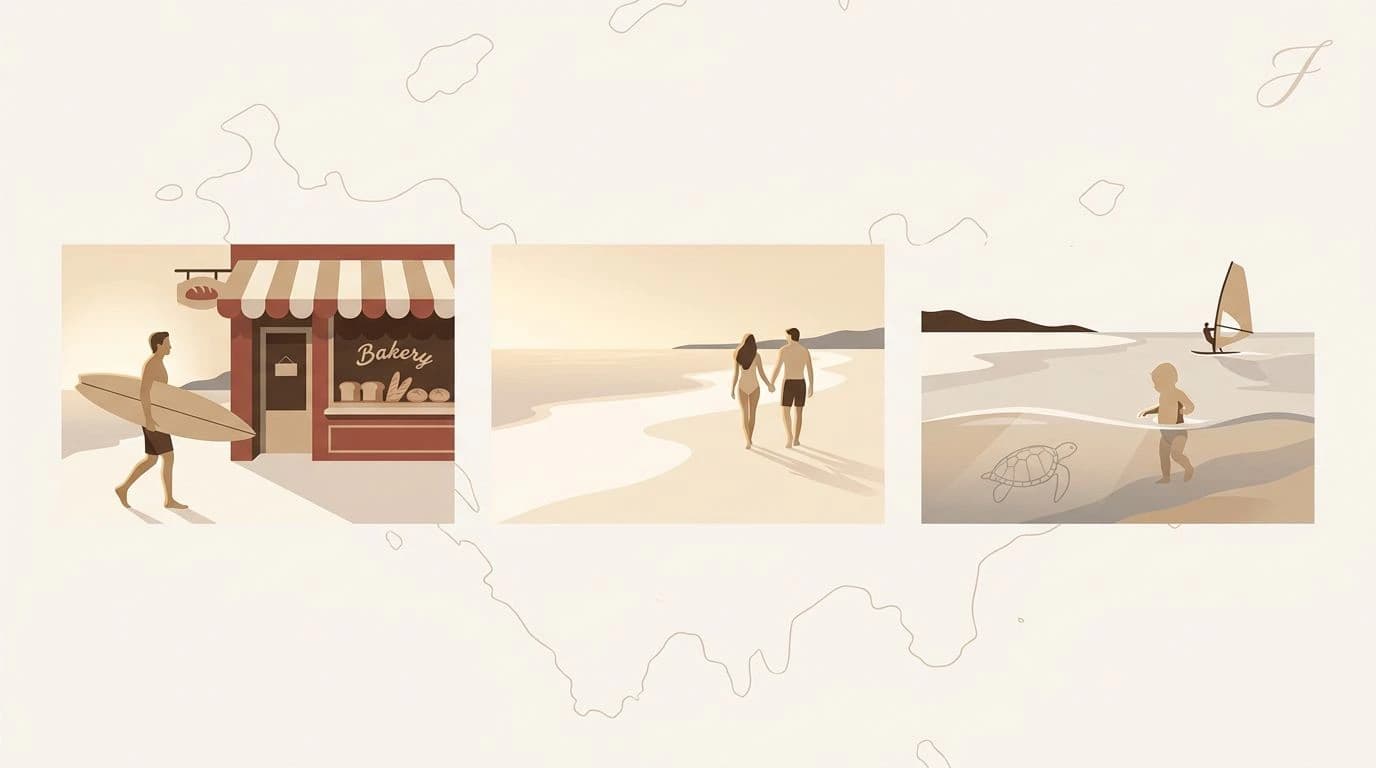
Late afternoon, board under one arm, the bakery still open.

Flamands: the wide scenic stretch
Flamands earns its own search volume because it looks, in photographs, like the postcard version of a Caribbean beach, and in person it mostly delivers on that. It runs nearly a kilometer along the northwest coast, backed by a line of hotels and villas rather than commercial beach clubs, with sand that stays soft and pale rather than packed. One of the widest and most scenic stretches on the island, with soft white sand running nearly a kilometer, better for walking and sunset than for calm swimming. Flamands beach St Barts is wide enough that even at full capacity in high season it rarely feels crowded, which is unusual for a beach this well known.
The common assumption is that Flamands is also a calm, swim-with-kids beach because it looks so sheltered in photos. It is not, reliably. Swell picks up on this stretch at various points in the year, particularly in winter, and conditions can shift from flat to choppy within a season. Guides that lump Flamands in with lagoon beaches like Grand Cul de Sac are skipping this detail.
Flamands works best for travelers prioritizing the walk, the view, and the sunset over guaranteed flat water. The hillside above the beach also holds some of the island's most photographed villa positions, looking straight down the curve of sand toward Colombier.
The same beach, at the hour the light turns orange.
Verdict: choose Flamands for scenery and space, not for swimming lessons with small children.
Grand Cul de Sac: the protected lagoon
Grand Cul de Sac sits on the east end of the island, behind a coral reef that runs roughly parallel to the shore, and that reef is the entire story of the beach. It breaks the ocean swell before it reaches the sand, turning the water inside into a shallow, warm lagoon rather than an open beach exposed to the Atlantic [saint-barth.org][rentalescapes.com][letoinyexclusive.com]. Sits behind a protective reef, which creates a shallow lagoon ideal for toddlers, non-swimmers, and water sports that need flat water. The practical result: you can wade out a long way before the water passes waist height on an adult, which is precisely what makes it the default recommendation for families with toddlers or hesitant swimmers.
What guides often compress into a single line, "calm and family-friendly," deserves more precision. The lagoon's calm water also attracts sea turtles, which feed on the grass beds inside the reef, and the same flat conditions make Grand Cul de Sac one of the better spots on the island for kitesurfing, windsurfing, and stand-up paddleboarding lessons aimed at beginners [saint-barth.org]. It is simultaneously a toddler beach and a watersports beach, which is less contradictory than it sounds once you understand that both activities need the same thing: water without a breaking swell.
This is also the part of the island closest to a resort-style beach experience, with a small number of hotels and beach restaurants along the sand, so travelers researching lorient hotels or a comparable beachfront hotel stay often end up comparing that option directly against a villa in Grand Cul de Sac instead.
The trade off: flat water and turtles, but a beach that can feel busier midday than Lorient, and less dramatic scenery than Flamands.
Matching beach to guest type, not ranking
There is no single best beach St Barts answer, because the question itself assumes one ranking applies to every traveler, and these three beaches disprove that on their own. A couple celebrating an anniversary, a family with a four-year-old, and a surfer on a solo trip are not optimizing for the same thing, so asking which beach ranks highest is the wrong frame.
Swell and shelter matter differently depending on what you came for. Grand Cul de Sac's reef creates flat water; Flamands and Lorient's western end are open to real swell. Scene and amenities vary: Flamands and Grand Cul de Sac have hotels and restaurants nearby; Lorient is residential and quieter. Activity fit follows from that. Lorient and parts of Flamands suit surfers; Grand Cul de Sac suits beginners, young kids, and flat-water sports.
Once you know which condition matters most to your trip, the beach choice determines the villa search, not the other way around. The beach a villa sits closest to should match how the week is actually going to be spent, not just how the villa photographs.
Beach choice and villa fit
St Barts beachfront villas are not interchangeable just because they share a shoreline, since the water conditions and village setting differ so sharply by location. A beachfront position in Grand Cul de Sac means walking distance to a shallow lagoon with a hotel or two nearby. A beachfront or hillside position above Flamands means a wide view and a long sand walk but less certainty about calm swimming. A villa near Lorient means a short drive or walk to a working beach with a surf break, bakery, and none of the resort infrastructure. Each beach pairs with a different villa profile: Lorient for a quiet residential base, Flamands for view-driven hillside or beachfront estates, Grand Cul de Sac for family-sized villas near resort-style amenities.
None of this makes one area objectively superior. Matching beach to guest type, not just picking "the best beach in St Barts," is the real planning decision.
Frequently Asked Questions
Is Flamands beach good for swimming with kids?
Not reliably. Flamands is open to Atlantic swell at points in the year, which can make it choppier than a sheltered lagoon beach. Grand Cul de Sac is the better choice for small children.
Is Lorient St Barts beach good for surfing?
The western end of Lorient has a consistent, moderate break that works well for learners and intermediate surfers, with several surf schools operating directly off the beach.
Are there hotels directly on Lorient beach?
Lorient hotels are limited compared to Flamands or Grand Cul de Sac; the area is primarily residential, which is part of its appeal for travelers wanting a quieter base.
Why is Grand Cul de Sac calmer than other St Barts beaches?
A coral reef runs along the bay and breaks incoming ocean swell before it reaches shore, creating a shallow, protected lagoon rather than open-water conditions [saint-barth.org][rentalescapes.com][letoinyexclusive.com].
Which beach is closest to restaurants and beach clubs?
Grand Cul de Sac and Flamands both have beachfront hotels and restaurants nearby. Lorient has village shops and a bakery but no beachfront dining scene.
Can one villa stay let us visit all three beaches easily?
Yes. None of these beaches are more than a fifteen to twenty minute drive from each other, so a villa based in one area still allows day trips to the other two.
About Art de Vivre Villas
Art de Vivre Villas is a boutique villa rental agency on St Barts, run directly by founders Dorian and Alexis rather than a large, high-volume booking team. Clients work with the same point of contact before, during, and after their stay, including help matching a villa to the right beach and neighborhood for how they actually plan to spend their days. The portfolio spans over 70 named villas across the island's neighborhoods, from Lorient to Flamands to Grand Cul de Sac, with 24/7 concierge service included on every booking. Inquiries receive a response within 24 hours, including for last-minute requests.
If you are weighing Lorient against Flamands against Grand Cul de Sac for your next stay, reach out to Art de Vivre Villas and tell us how your days are likely to go. We will point you toward the beach, and the villa, that actually fits.
References
- Where to Stay in St Barts: The Neighborhoods (saint-barth.org)
- Where to Rent St Barts Beachfront Villas: A Complete Area Guide | Rental Escapes (rentalescapes.com)
- Where to Stay in St Barth - Le Toiny Area Guide (letoinyexclusive.com)